How The University of Montana (under)funds athletics – Part 2
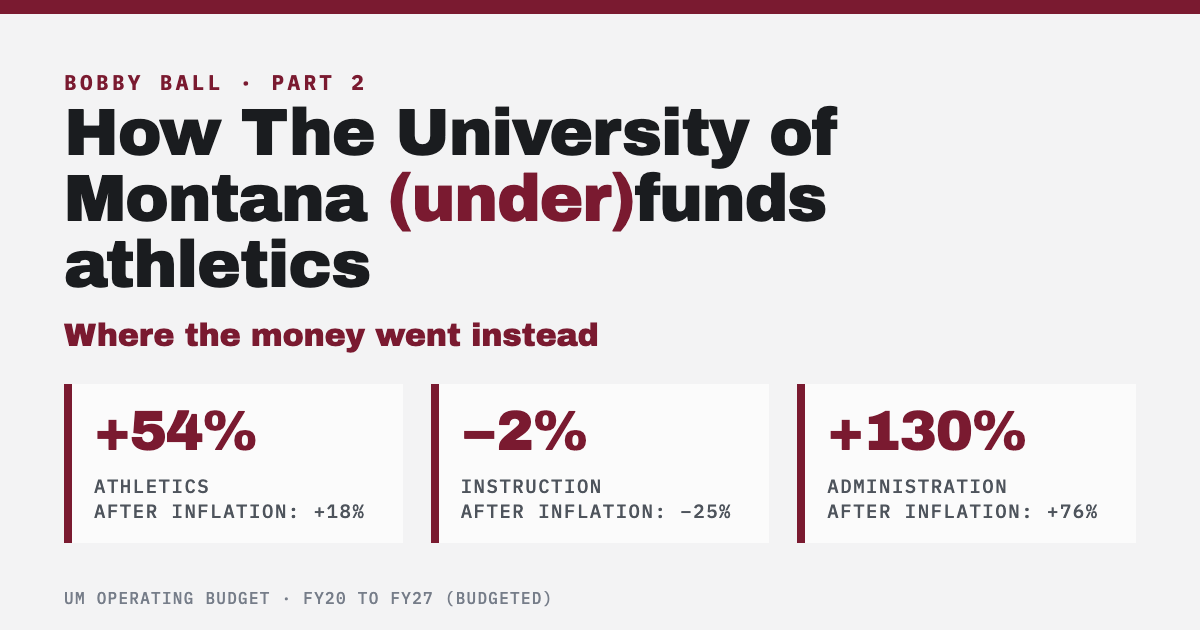
UM’s admin spend grew 130% the last seven years, while athletics rose 54%. Over that span enrollment went up 8% and classroom instruction spending fell 2%. In March the budget committee put athletics first among its “top recommendations for reductions.”

How The University of Montana (under)funds athletics – Part 2
UM’s admin spend grew 130% the last seven years, while athletics rose 54%. Over that span enrollment went up 8% and classroom instruction spending fell 2%. In March the budget committee put athletics first among its “top recommendations for reductions.”
After inflation: +18%
After inflation: −25%
After inflation: +76%
What UM’s operating budget spends on each, FY20 to FY27 (budgeted). Athletics includes athletes’ tuition waivers, the general fund’s loan payments for athletics and the student fee, as in the chart below.
“There’s not a lot of fat at the university. We’ve been through over a decade now of quite a few cuts, right?” That was one of the hosts on the Griz Fan Pod reacting in real time to Part 1, and that host works at UM. That’s the standard line we’ve all been led to believe, and I don’t blame him for repeating it.
Stacey Eve, UM’s associate vice president for operations and finance and the chair of the University Budget Committee, answered Part 1 in a series of Facebook comments Monday night. One, to another fan: “Students also expect their tuition dollars to go towards their education.”
Those are the two objections I hear most when I say UM should put another $4.2 million a year into athletics. There’s no fat, and if there were, it would have to come out of somebody’s classroom. Neither one is true.
The fat is in administration
UM’s own budget summary for this year says student instruction is 40 percent of the general fund, 10 percentage points below the Regents’ target of 50. Anybody who has taught on campus the last ten years has earned the right to complain, and nobody should go looking for more athletics money in Urey Underground. The dollars aren’t piling up in lecture halls, and they certainly aren’t ending up on the football field, so just exactly where are they going?
Turn your attention to Main Hall. In UM’s general operating budget, the line for running the place, administrative costs, has more than doubled in seven years, to $26.1 million in fiscal 2026.
| Share of budget | Dollars | Share | Since FY20 |
|---|
All years, in millions of dollars
The Montana University System keeps an official list of a dozen peer schools for UM, from Idaho State and Northern Colorado to Wyoming and the Dakotas. In its federal filing for 2023-24, UM reported more full-time managers per student than any of them. It’s not just per capita either. Montana’s 396 managers are also the highest raw count, above Utah State (380) and UNLV (258), which each have about three times UM’s students. There could be some job categorization quibbles, but I doubt those can fully explain a gap this large.
During the five years up to that 2024 filing, payroll for UM’s administrative staff—the managers plus the business office and the clerical staff—grew 51 percent, faster than at Montana State, Idaho, Wyoming or the flagships and land-grants in either Dakota. UM finished those five years with fewer students than it started with.
Over nearly the same stretch, fiscal 2020 to 2024, UM’s general-fund instruction budget fell from $67 million to $59 million. More money for the administrators, less for the educators. Had administrative payroll, counted across every fund, grown only at the same pace as those neighbors, it would be $6.2 million a year smaller, $2 million more than what I’m asking the school to send athletics. If administrative payroll per student matched the system’s official peers, it would be $10.6 million smaller. Not every dollar of that is general-fund money, but it well covers the $4.2 million for athletics that I asked for in Part 1, plus another $6.4 million for the classroom.
The budget committee decided the league’s smallest university check was the fat in the budget
In March the University Budget Committee had to close a hole in this year’s budget (FY27). All departments were required to offer options for cuts. All told, the committee ranked 22 proposals. No. 1 was “Athletics - Travel reductions.” No. 3 was “Athletics - Recruiting budget reductions.” No. 4 was “Athletics - Program budget reductions.” Athletics had offered $160,000 in cuts, but senior leadership took $389,000. The vice president for student affairs offered about $319,000 in cuts and wasn’t required to cut any.
At the same March meeting the committee ranked spending requests as well. Athletics asked for $745,000 for “Scholarships and updated banners” and landed 17th. Three spots higher sat “Marketing - University-wide Employee awards and employee social hours.” Price tag: $16,900. I have no quarrel with an employee social hour. I’d like an invite, but not above athlete scholarships. Also ranked above athletics’ request: $209,990 for marketing hires (5th); $617,203 requested by Operations and Finance to hire staff and move Finance, Custodial and Facilities positions onto the general fund (7th); and $229,987 to restore Operations and Finance’s operating budget and the Griz Walk program (10th). That’s over a million dollars not on a field or in a classroom.
Let’s look closer at the committee. Eve chairs it as I’ve said, and it answers to her boss, the vice president for operations and finance, Paul Lasiter, who in turn reports to the President. Lasiter’s first full budget was FY20, where athletics got about $8.5 million in school and student money. The admin allocation that year was $12.0 million. Seven years later this last March, athletics got about $13.0 million. Admin got its sixth increase in seven years, up to $27.5 million.
Eve sat on the committee’s budget-model group in Lasiter’s first year. When COVID losses put UM back in deficit in 2021, she told the Montana Kaimin that athletics took a hit because, in the paper’s words, the department “tends to spend all the revenue it generates annually.”
In November 2024, the committee’s minutes gave Lasiter two follow-up tasks: “data about the ROI from athletics” and “information on the economic impact of athletics on the university.” No other department’s return on investment made the list. To his credit, the same minutes have him encouraging a conversation about allocating more resources to athletics, given what students pay in the athletics fee. It still says plenty about the attitude in that room that the least school-funded athletic department in the league is the one asked to prove it’s worth the money.
Back to this March, the committee ranked more than a million dollars in new spending for marketing and Operations and Finance above athletics’ scholarships, the administration line went up again in the budget that followed, to $27.5 million, and the committee identified the place most worthy of a cut: “The committee’s top recommendations for reductions targeted athletics and research.”
The athletic department appeared quite displeased with the cuts they were asked to propose and said so in the most aggressive terms corporate speech allows, in its entry in the committee’s summary: “Designated funds have been insufficient in past years and sustainability will be dependent on future revenue.”
In other words: you stiffed us again, and the fans will be left with the bill.
Winning grows the pie
Everybody arguing about this treats the budget like a fixed pie, where every dollar for football is a dollar out of a lecture hall. The pie isn’t fixed. It grows when more students enroll, and every new student brings tuition and state funding that pays for classrooms. The trick is getting more students, which UM has struggled to do.
Winning football games is a surefire way to get more to apply, and this has been studied by economists who don’t own a single piece of maroon. A national title season brings nearly 8 percent more applications that same year. The year after a title, about 12 percent more students send a school their SAT scores, and out-of-state kids respond at more than twice the rate of in-state kids. A Berkeley economist found every extra win brings more applicants, better test scores and more in-state students.
We have run this experiment ourselves. In the ten seasons that ended in 2010, Montana football won nine Big Sky titles, played in four national title games and won one. UM’s enrollment peaked the next fall, at 15,669, and it hasn’t been back since.
Bozeman is running the same experiment right now. After winning the title in Nashville on ESPN in January, a school spokesman said, “We’re going to see more applications.” Most of this fall’s freshmen had already applied by then. The class applying right now is the real test, and we’ll get to watch it longingly from 200 miles away.
Bodnar’s administration wanted more students and spent plenty marketing the University to high schoolers. Last year (FY26) the university put a million general fund dollars into enrollment marketing. The marketing office’s own general-fund budget this year is $5.2 million, more than the $4.2 million I’m asking for athletics. At the same time the budget committee ranked the best advertising engine the university owns, Grizzly Athletics, at the top of the cut list.
Eve tied the athletics check to enrollment, “grown as enrollment has rebounded.” That treats athletics like a line that rides the student count, which reverses the research. Freshmen follow the wins; wins don’t follow the freshmen.1
FCS schools our size have less money and give athletics more
Take every public FCS school that made the playoffs in the last three seasons and runs on tuition and state money within 30 percent of ours. That’s 12 schools, Montana included, from South Dakota and South Dakota State to Austin Peay and Tarleton State. Every other one of them puts a bigger share of its tuition and state money into athletics than UM does. The typical one puts in twice our share.
They aren’t doing it because they’re richer. Per student, UM has more tuition and state money to work with than any school on the list.
For every dollar UM takes in from tuition and the state, it spends about 49 cents on instruction. The typical school our size spends 61.
The administrative office is where it shows up. UM spends about 19 cents of that dollar on administration. UM spends more than $3 on administration for every dollar it gives athletics. The typical school our size spends about $1.65, and no school in the group spends more than UM.
The general fund is a choice, and UM chooses athletics last
Eve’s primary response to my article came in two lines. First: “if Athletics generates more money than other schools in our conference, why would they need more tuition support?” Then: “There’s only so much money to go around, and universities have competing priorities.”
The athletic department needs the support because what football generates is paying for the sports the university won’t, nullifying the advantage of our tremendous fan support. Every university has competing priorities. Every playoff school our size has them too, and still gives athletics a bigger share. UM’s budget committee ranked athletics as the top candidate for cuts.
As for the money UM doesn’t have, the state sends UM more per Montana student than it sends Montana State, $14,916 to $13,945 under the Regents’ allocation this year. Bozeman has more students. It does not have a richer deal from the state. Eve may be right when she told me, “UM doesn’t have the money MSU does. We probably never will.” Nobody asked it to. Part 1 asked only for athletics to be funded at the Big Sky median. Eastern Washington and Northern Colorado, two schools nobody has ever called rich, both find a way to clear it.
Eve’s line about tuition holds up fine. Students do expect their tuition to go towards their education, and I agree with them. I don’t think they count the administration as part of it. Give them the choice between more administrators or a better team, most pick football. They aren’t getting educated at an employee social hour either, and our administrative office isn’t teaching anybody calculus.
Two attitudes toward the same front door
Waded Cruzado ran Montana State for fifteen years. On her way out, before her last Cat-Griz game as president in November 2024, she said that “in the state of Montana, football speaks for our culture.” After she announced her retirement, she told the Bozeman Daily Chronicle she hoped the next president “will see athletics as an asset, as a force for good.” She put the university behind football from her first year, when she took a plan to the Regents for up to $4 million of university financing to expand Bobcat Stadium, to be paid back out of ticket sales and other athletics revenue.
Football was her vehicle, not her whole agenda. On her watch Montana State grew by 33 percent to a record enrollment, more than doubled its research spending, became one of the country’s top research universities and raised more than $850 million from donors. Her football teams made ten playoff trips in fifteen seasons, won five Big Sky titles and played for two national championships, and the team she left behind won it all in January. The rest of the athletic department came along with it: three straight NCAA tournaments in men’s basketball, and nine straight Brawl of the Wild trophies, dominating the University of Montana in sports for nearly a decade.
The chair of UM’s budget committee answered my column on the smallest university check in the Big Sky in a different tone: “There’s much more to UM than football.”
Of course there is. Nobody in Bozeman thinks Montana State is only a football team either. The difference is what each school does about it. One treats football as the culture it is selling. The other treats it as a line item to minimize. As a small element of the school, divorced from its academic mission, rather than its unifying identity. When that is the attitude of the person who chairs the budget committee, it’s fair to say it was probably the attitude in Main Hall under the previous President.
Thankfully Main Hall has a new occupant. President Shinn moved in this July, after this year’s budget was built, and he has already called Grizzly Athletics “the front door to the University.” It’s time our university leaders treat the athletics department and its athletes as an asset and force for good. It’s all hands on deck. The fans keep believing, donating and showing up, and have for years. The students can do a little more, if somebody makes the case to them. The university must do the rest. Nobody has to cut men’s tennis. Nobody has to cancel a class. UM just needs to step up and reprioritize.
Let President Shinn know why Griz football matters to you. Tell him you read the budget committee’s rankings. Tell him the money is there, and where. The budgeting process for FY28 is already underway.
Go Griz.
Bobby Ball · The ask
Write to President Shinn
Speak from the heart and don't sweat the wording. The form tidies up your writing and adds the numbers that back you up. Nothing sends from this page: your letter opens in your own email, where you can change anything before you hit send. Be warm, don't be a jerk. He'll read the nice ones.
0 Griz fans have written President Shinn
Letters by town
Privacy: nothing you type here is sent anywhere except to your own mail app. The only thing counted is that a letter was written, and the town.
The student fee is the smallest lever
Many conversations I’ve seen about this turn into a conversation about the student fee, probably because it’s the number printed on every student’s bill. It’s also the smallest lever on the table. Raising ours to the league median of $205 a year from the current $184, which UM should consider, barely moves the number, filling in about $150,000 of the $4.2 million the department is shorted each year. If UM got back to 15,000 students, the student athletic fee revenue would grow by a few hundred thousand dollars. We could double the undergrad enrollment and it’d only add a million to the athletics budget.
There’s a bigger lever than the fee, and it sits in Main Hall. Every year UM charges athletics an internal assessment, an overhead charge on the money the department raises and spends on its own. It goes to the general fund, where the committee’s minutes describe its “role in supporting university operations.” Athletics paid $956,854 last year, and this year’s budget has $925,000. The more the department spends, the more it pays: the minutes have Lasiter noting in 2023 “an increase in administrative assessment due to increased spending.” Stop charging it, and athletics has about another $1 million a year to spend, six times what raising the fee to the league median would bring.
And getting a fee through here is hard. Fees move once every two years, student government gets its say first, and the last time the Regents set them they held increases at or below 3 percent a year in the aggregate. The students could chip in a little more. They can’t carry it.
The Regents ask for competitive. UM chooses otherwise.
The Regents’ policy says athletics should be funded so the schools can be “competitive in their respective conferences.” Montana not doing so is a conscious decision, not a mandatory one, and many of our sports have not been all that competitive of late. Somebody makes the decision every year, and somebody can make it the other way.
Old information? This year’s budget says the same thing
Eve’s initial defense on Facebook was the calendar. “I’m guessing you’re looking at old information,” she wrote, and later, “It’s FY27 now.” This year’s budget, set after her committee’s recommendations, has the administration line going up again, to $27.5 million, while athletics’ share of the general fund goes down, and instruction stays below the level it was seven years ago in FY20.
On Facebook, Eve wrote to me that “the institutional contribution to Athletics has grown as enrollment has rebounded, including the current fiscal year.” This year’s general-fund allocation, as the budget office laid it out in March, has athletics going down $192,715, in a year the university’s general fund went up 1 percent. Whatever grew this year, it wasn’t that.
She’ll point to last year. UM’s overall general budget went up $17.6 million in FY26, by the budget office’s own Expenditure Growth and Allocation Report. Athletics got $3.3 million. Almost none of it touched a field. It moved salaries the athletic department had been paying out of its own revenue (fan money) onto the general fund and repaid a loan that had covered the department’s past shortfalls. The committee’s minutes say what the freed-up money could now cover, such as “unfunded student scholarships in athletics, which had accumulated deficits due to rising costs and insufficient outside revenue” (blaming the fans). That is the school catching up on a bill that piled up while it wasn’t paying its share.
The extra $15.5 million went to people
UM’s budget books break the administration line into the accounts it spends from. In FY20 the line spent $12.0 million. This year’s budget gives it $27.5 million. Of the $15.5 million difference, $13.2 million is salaries and benefits, and the biggest single piece is contract professional salaries, which went from $2.2 million to $9.0 million.
The headcount moved with it. UM’s budget reports its full-time staff by type every year. In FY20 the general fund paid for 144.6 full-time professional staff across campus. This year’s budget pays for 268.1. Faculty on the general fund went the other direction, from 550.5 to 500.4.
UM doesn’t say who the new professional staff are, but its federal filings show where the full-time jobs went. Between fall 2019 and fall 2023, UM’s managers went from 281 to 396, its business and finance staff from 129 to 156, and its computer, engineering and science staff from 197 to 260. Its instructors went from 469 to 408. Office and clerical staff fell from 147 to 88, so some of those manager jobs may be clerical jobs with new titles. Count managers, business staff and clerical together and the group still grew from 557 to 640. The budget committee’s office-by-office list for FY24 shows some of what that buys: an office of Analysis, Assessment and Data Integrity at $830,000, an Inclusive Excellence office at $620,000, and six marketing offices at $4.3 million. This year the marketing division draws $5.2 million from the general fund. Those lists don’t say which offices sit in the administration line, so the match is mine, not UM’s.
In 2023 the committee’s minutes have Eve walking through the administration line, “specifically noting that a lot of the expenses are repairs and maintenance, insurance, organizational dues, etc.” This year the line has $1.8 million for repairs and maintenance and $27.8 million for pay and benefits, more than the whole line, because the line is net of a $9.0 million credit.
The fair objection is that some of this is money changing accounts: costs UM used to pay out of other funds that now show up on the general fund. The federal filing counts every fund. There, UM’s administrative salaries in Missoula went from $12.7 million in FY20 to $19.3 million in FY24. The general-fund line’s salaries went up $6.7 million over the same years, almost exactly the same amount. Those are new paychecks, not old ones moved.
Athletics isn’t hiding in it either. In FY26, when UM moved $2.3 million in athletics salaries onto the general fund, the administration line went up $1.0 million and the student services line went up $4.2 million. If anything, the money runs the other way: the athletic department’s own ledger shows it paid the university a $956,854 “Internal Assessment” last year.
Eve also wrote to me that “there has actually been quite a lot of structural work done to the stadium that doesn’t show up under Athletics.” The Regents’ records show what it was. UM’s 2022 project report lists $651,000 of stadium concrete and plaza repairs and a $590,000 north elevator as complete, paid for with bond money set aside to maintain buildings that run on their own revenue. The 2019 breezeway waterproofing and men’s basketball locker rooms came “entirely from private support.” This spring’s new turf and field pads are “paid for using private funds.” None of the stadium projects the Regents have approved since 2017 used general-fund money, and this March’s minutes record Lasiter saying “virtually none of the university’s debt is paid from the general fund.” The stadium work doesn’t show up under Athletics because it doesn’t show up in the general fund at all.
What the published documents don’t show is which offices the $15.5 million paid for. UM doesn’t publish the administration line by office. Everything in this piece comes from what the university does publish. If it thinks the picture is different, it can make the documents available, and I’ll update the figures.
To the budget office, athlete scholarships are just waivers
In 2023 the minutes have Eve noting that the athletic scholarships on UM’s budget submission “are waivers, not funded scholarships.” Making the point they are a non-cash transaction, and add no revenue.
Winning works like a tuition cut
A Harvard Business School study put a price on winning: going from mediocre to great on the football field drew as many additional applications as a 4 percent tuition cut.
How this piece counts what UM gives athletics
Unless a sentence names the general fund, every athletics figure in the tiles, the donut and the text counts the same thing, the way UM reports it to the NCAA: the school and student money that reaches the athletic department. That is the general-fund allocation, plus tuition waived for athletes and the student athletic fee, less money the department transfers back to the university. FY20 to FY25 come from UM’s reports to the NCAA (FY21 and FY22 leave out $1.5 million and $1.9 million of one-time COVID-era money). FY26 comes from UM’s own year-end ledger, counted the same way: the $1.4 million athletics transferred back at year end comes off. FY27 is an estimate from the adopted budget, counted the same way.
Counted that way, athletics went from $8.5 million in FY20 to about $13.0 million this year, up 54 percent and 18 percent after inflation. The general-fund line alone went from $4.3 million to $8.5 million, but most of that jump came in FY26, when UM moved $2.3 million in salaries athletics was already paying, plus a $750,000 loan payment, onto the general fund. Instruction and administration are UM’s general operating budget lines (administration is the institutional-support line). Inflation is the consumer price index (CPI-U), the FY20 average against July to September 2026.
Eve wrote that I was “excluding loans from the university.” A loan isn’t a contribution. The one the documents show covered the department’s past shortfalls: the committee’s November 2025 minutes describe money to “address historical negative fund balances in restricted funds,” and in FY26 the general fund made a $750,000 payment “to repay a Restricted Fund shortfall loan,” which this piece counts as university support. Athletics also pays the university about $2 million a year in debt service and the internal assessment, and like UM’s NCAA reports, these figures leave those in as the department’s own expenses.
I’ll admit I cite different years in different places. Most of my comparisons with other schools run a couple of years behind for one reason: they come from the federal filing every university makes the same way, and the government publishes them on a delay. That means 2023-24 for staffing, payroll and spending per student, and FY25 for other schools’ athletics budgets, which come from the reports every school files with the NCAA on a similar delay. UM’s own budget lines come from its budget books and run through last fiscal year, FY26, plus this year’s adopted budget.
1 I did not find any research indicating increased administrators led to enrollment gains.