The state capped athlete pay at $1.5 million. Montana State is at $2.3 million.
Montana State has contracted to pay its athletes $790,000 more in rev share than state rules allow
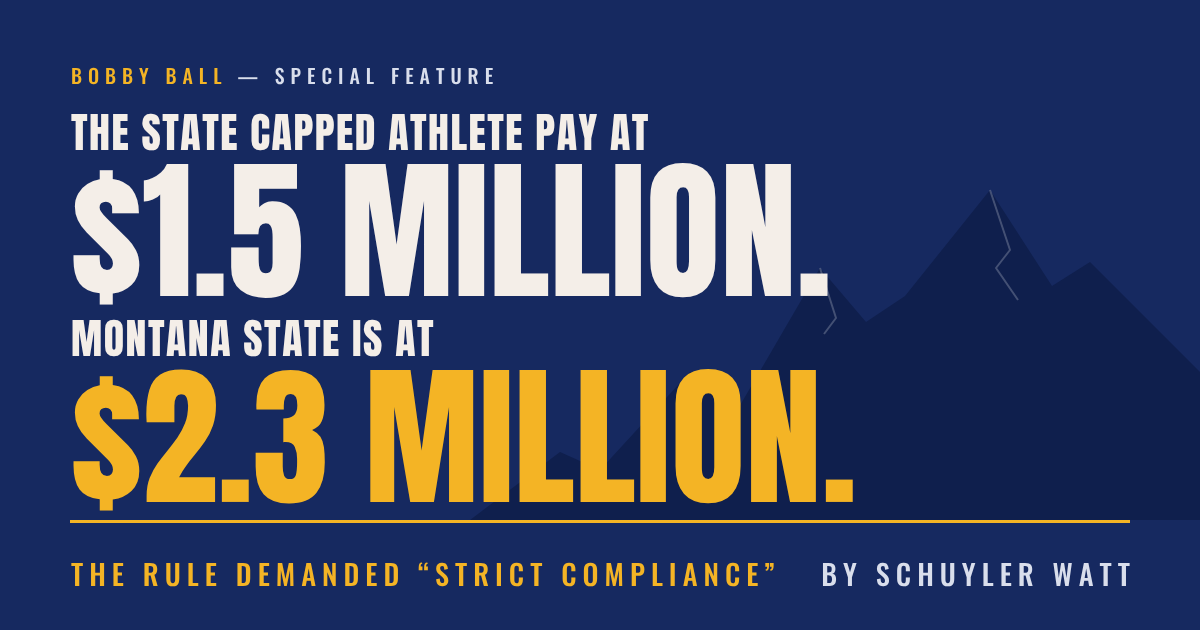
The state capped athlete pay at $1.5 million. Montana State is at $2.3 million.
Montana State has contracted to pay its athletes $790,000 more in rev share than state rules allow
Every sport combined
Over by $790,752.50
Under by $8,962
Direct pay to athletes for 2026-27. Montana State: the spreadsheet its legal office produced Oct. 30, 2026. UM: its Nov. 12, 2026 statement and the payment file it produced in response to a records request.
Since July of last year, colleges have been allowed to pay their athletes directly. That’s revenue sharing, or rev share. The State of Montana put a limit on it. Clayton Christian, the Commissioner of Higher Education, who runs the university system, told each university it could pay its athletes up to $1.5 million a year. His memo demanded “strict compliance.”
Montana State’s number for this year is $2.3 million. The University of Montana is at $1.49 million. MSU’s football team alone is at $1.57 million, more than the limit for the whole athletic department.
The $2.3 million comes directly from MSU. Its legal office sent me a spreadsheet in answer to my records request for “total payments to student-athletes under the [House] settlement,” and $2,290,752.50 is the total on its 2026-27 tab. On November 13 the university told me in writing that every amount on that spreadsheet is payable to an athlete under its revenue-share agreements. The same morning the Commissioner’s office told me the cap counts every payment a campus makes under a revenue-share agreement. Montana State is committed to $790,752.50 more than the cap allows. On the records I have, it had paid $1,030,890 by September 9. Those records stop there, so I can’t say what it has paid since. Its contracts take it past the cap.
Plenty have wondered how Montana State kept its championship roster together. It has loyal and talented players, to be sure. It has also contracted to pay seven football players a total of $929,212.50, which is 62 percent of the entire department cap before the rest of the roster receives another $639,090. UM’s entire football rev share is $1.1 million with one line above $100,000. UM pays about 60 football players. Montana State’s tab has 106.
Exceeding the cap by 53 percent makes it easier to keep players who might have otherwise left for a bigger offer. That’s a huge advantage across all their rev share sports, and Montana State got it by going past a limit UM stayed under. UM is playing by the rule. Montana State isn’t, and that should make Griz fans mad.
I’m one of those Griz fans, and I’m writing about Bobcat money, which is why every MSU record I cite is listed with this piece. Check me.
The State of Montana capped athlete pay at $1.5 million and demanded “strict compliance”
Until 2025 the NCAA didn’t let schools make direct payments to athletes beyond scholarships and academic expenses. That ended on June 6, 2025, when a federal court approved the settlement of House v. NCAA, an antitrust lawsuit brought by athletes. Starting July 1, 2025, a university could pay its athletes directly for the use of their name, image and likeness, or NIL. The school itself writes the check. The national limit was set at $20.5 million a school.
Deals an athlete signs with outside groups, like a private booster collective, are a different thing. Under the settlement, any of those worth $600 or more has to be reported to a national clearinghouse called NIL Go. The deal has to be a real exchange for a real business purpose at a fair market price. It can’t just be a payment.
Schools outside the biggest conferences had to choose whether to join the settlement. Montana State announced in March 2025 that it would join, followed by the University of Montana in June.
In a memo dated July 1, 2025, the day the new rules took effect, Commissioner Christian wrote to the presidents and athletic directors of the Montana University System. The Commissioner is the system’s chief executive, appointed by the Board of Regents. His memo set the state’s limit, far below the national one. The rule runs five sentences:
“Consistent with state and federal law and the terms of the settlement, institutions may directly compensate athletes for use of NIL. Total compensation paid by an institution shall be subject to an annual cap of $1.5 million per university. No state funds may be used to compensate athletes. Revenue for the $1.5 million must be from private sources. In order to ensure strict compliance with this compensation guidance, the system may require audits of a university’s athlete compensation program.”
MSU records show they are contracted to pay athletes $2.3 million this year
On September 16 I filed multiple records requests with Montana State, including one which asked for “Every revenue-sharing agreement under the House v. NCAA settlement between the University and a student-athlete” in every sport, with any amendments. If MSU kept “a list, ledger or spreadsheet of these agreements or payments,” I said I’d take a copy “showing only sport and amount, in place of the agreements themselves.”
That spreadsheet was delivered to me October 30, showing $2.3 million in revenue share payments for athletes for 2026-27. The same records release also included Montana State’s “Student Athlete Revenue Share” ledger and its blank contract forms.
Montana State’s word for the spreadsheet was “Proposed.”
Asked to explain, Montana State claimed only $1,485,950 of it counts
I sent MSU questions on November 5. Four days later Michael Becker, Montana State’s vice president of university communications, answered by email. My second question began “Is $2,290,752.50 MSU’s contractual obligation to athletes for 2026-27?” His answer began “No.” The figure, he wrote, “includes other forms of support provided through MSU Athletics that are not direct payments under the Montana University System’s $1.5 million limit, such as full cost-of-attendance scholarships, meals and nutrition support, insurance and permissible stipends.” Then the number: “Direct compensation for 2026-2027 is $1,485,950, which is within the MUS annual limit.”
So I asked for the documentation. Two of my follow-up questions take one word and one number to answer.
Four days later MSU said all $2.3 million is payable to athletes under contract
The answers came November 13. Is every amount on the spreadsheet payable to a student-athlete under a Licensing and Endorsement Agreement or RevShare Amendment? “Yes.” What total has MSU contracted to pay under those agreements? “See information previously provided in request 26-206b.” That’s the spreadsheet, and the spreadsheet says $2,290,752.50.
Four days earlier the same number was not a contractual obligation. Both answers can’t be true. If every amount on the spreadsheet is payable to an athlete under a contract, then the total is what Montana State is contractually obligated to pay. Montana State produced no new record in those four days. It changed its answer.
The Commissioner’s office answered the same morning, through Leanne Kurtz, its communications director. “Does the cap count every payment a campus makes to a student-athlete under a revenue-share agreement?” “Yes.” Is the cap in effect this year with no exception for any campus? “Yes.”
It doesn’t matter whether Montana State wants to later call the money cost of attendance, insurance, food, or anything else. Montana State can try to relabel the payments now, but that’s not what they are, and the math doesn’t work either. If it’s paid to an athlete under a revenue-share agreement, it’s a direct payment to an athlete. The agreements say so themselves. The compensation “is solely and exclusively in consideration for the University’s limited license to use the Student Athlete’s NIL Rights.” The only dollar blank on the amendment form is labeled “Updated NIL Amount.”
Montana State made its table after I asked, and it doesn’t hold up
With the “Yes” came a table, Montana State’s support for the $1,485,950 figure.
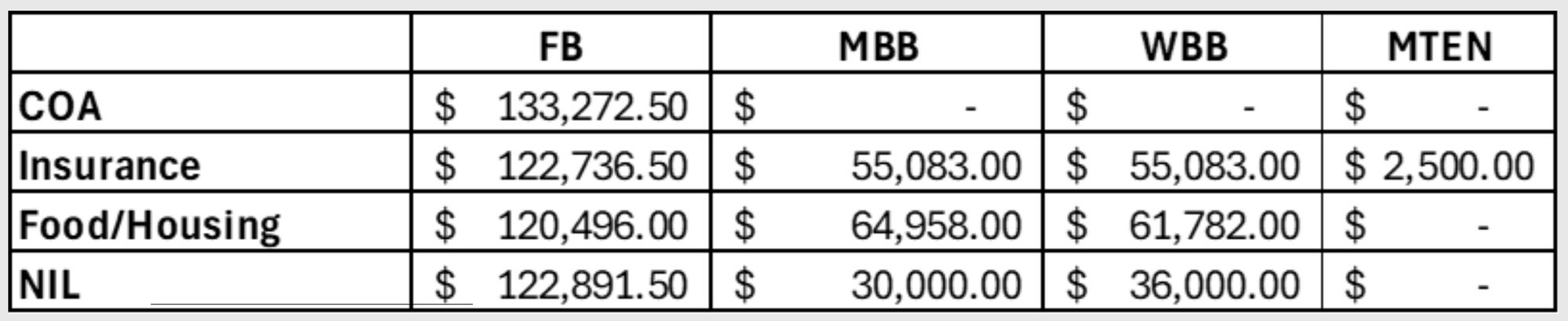
Those four rows are what Montana State claims it can take out of the $2.3 million it committed as direct payments: cost of attendance, insurance, food and housing, and an unexplained row labeled NIL. No further sourcing was provided for these figures and they don’t tie out to the other documents MSU previously produced.
Start with when it was made. I’d asked when the split was first prepared, and Becker answered: “The specific summarized table above was prepared in response to your follow-up questions.” So the number came first, and the support for it came four days later, after I asked. The only support is a table of numbers that add up to exactly the gap between the spreadsheet and the number Montana State had already given me.
Montana State says there is more behind it: “the student-athlete detail for the 2026-2027 year started in December 2025.” If that detail exists, Montana State hasn’t shown it to me. I asked for the record behind the split on November 9 and got the table. It could have been produced under my September records requests too, if it existed.
It doesn’t match the first answer. On November 9 the money was “full cost-of-attendance scholarships, meals and nutrition support, insurance and permissible stipends.” The table has no stipends. And the table has a row the first answer never mentioned, labeled NIL.
On cost of attendance: I asked whether that money goes out through the financial aid office, like a scholarship, or out of the revenue-share account. Montana State’s answer: “Football cost of attendance is paid out of the revenue share index while other sports include cost of attendance as part of the financial aid package.” So for football it isn’t a scholarship. It’s cash, paid under an NIL agreement, that Montana State now calls cost of attendance. The two aren’t the same thing. Cost of attendance is a figure a school’s financial aid office sets under federal rules, and with limited exceptions the NCAA caps an athlete’s financial aid at it. Maybe that’s how somebody in Bozeman thought of it. The agreement never uses the words, and the cap counts every payment under it.
On the NIL row: $188,891.50 that Montana State subtracts as something other than direct compensation. Its contract, again, pays “solely and exclusively” for NIL rights. Montana State’s table takes NIL money out of an NIL contract to get under an NIL cap. Just put that one row back and Montana State’s number is $1,674,841.50. Accept every other row of the table as true, with nothing behind it, and that one row alone still puts Montana State $174,841.50 over the cap.
On insurance: the agreement says the Fees “Will not include or cover Social Security, insurance, or other payments owed to an agent or other representative of the Student Athlete.” Montana State’s table puts $235,402.50 of insurance inside those same Fees.
The University of Montana has followed the $1.5 million cap rule
I sent the University of Montana a similar records request and similar questions. I asked Dave Kuntz, UM’s vice president for marketing and communications: “What total has UM contracted to pay student-athletes in revenue share for 2026-27?” and “Does UM count every payment under those agreements toward the cap?” He answered on November 12.
“To date, UM has made $566,916 worth of direct payments to student-athletes for the 26-27 school year. We have commitments on our books to pay out another $924,122 by the end of the 26-27 year. The total direct payments to student athletes for the 26-27 year will be 1,491,038.”
On what counts:
“UM counts all direct payments made to student-athletes towards the $1.5 million revenue-share cap. We do not count scholarships or other educational benefits provided to student-athletes, such as Alston and cost of attendance payments, against the revenue share cap.”
UM counts every direct payment toward the cap. Montana State told me every amount on its spreadsheet is payable under a rev share agreement, and it counts $1,485,950 of the $2,290,752.50.
UM’s response to the records request included its payment file, which matches that total.
The Commissioner required an NIL policy. Montana State says it hasn’t adopted one.
The Commissioner’s July 2025 memo also says “Schools must adopt a policy governing direct payments to student-athletes for NIL.” I asked whether Montana State had adopted one. The answer: “we have not adopted a separate policy.” Becker says the Commissioner’s guidance “is incorporated into contracts with student-athletes.”
My September records request had asked for “Any written policy, plan or memo setting the total amount the University will provide to student-athletes under the House v. NCAA settlement, or how that amount is divided among sports.” Montana State’s legal office answered on October 30: “There are no records in response to this request.”
I’ve read the blank contract. The Commissioner isn’t in it, and neither is the cap. It does point to “the University’s policy and procedures for name, image and likeness.” Montana State’s published athlete NIL policy took effect July 1, 2021, four years before a school could pay an athlete directly. It covers deals with anyone “other than the University,” and it says an MSU employee may not be involved in “directly or indirectly providing compensation to a student-athlete.” That is not the policy the Commissioner required. No policy is no policy, and that’s a second deviation from the Commissioner’s guidance.
The Commissioner demanded “strict compliance.” His office has ordered no audit.
The standard in the Commissioner’s July 2025 memo is strict compliance. The memo leaves the penalty unwritten. A rule that expects strict compliance leaves no room for a campus to go over by more than half and explain it later.
I asked Kurtz whether the Commissioner has “ordered an audit or review of any campus under the memorandum.” Her answer: “No.” And I asked: “What is the consequence for a campus that exceeds the cap, or has contracted to exceed it?”
“The Commissioner’s Office would review any noncompliance with the campus.”
Reviewing noncompliance without a penalty attached means the rule had no meaning.
Blatant disregard for the Commissioner’s rules should put every athlete payment under audit
An audit of the rev share alone isn’t enough. Rev share is only the part of athlete pay that runs through Montana State’s books. Outside deals run through private groups, and Montana State’s legal office told me the MSU Alumni Foundation and the Bobcat Collective “are separate from the university and are not subject to public records requests.”1
The Collective told its donors something else. A page on its site titled “Revenue Share Contributions” said: “Thanks to our new partnership with Montana State and the Alumni Foundation, donors can now make one-time tax-deductible charitable contributions directly toward Revenue Share. These dollars flow to our coaches, who distribute them to players in the way they see fit.” The Collective’s site was down when I checked on November 14. The page as I archived it September 22 is here.
The Quarterback Club sells memberships from $600 to $10,000 and takes its gifts through the MSU Alumni Foundation. Its site quotes head coach Brent Vigen saying the money goes where it will “allow us to recruit, develop and retain our student-athletes.” The emphasis is mine.
I’m not saying the Collective or the Quarterback Club has made an improper payment. I’m saying a violation of the rev share cap this plain should make any neutral party want the whole payment setup reviewed, however the money moves. The cap was the easy rule for one internet fan to check, on public records, and it wasn’t followed. The House settlement’s rules are more opaque and get less public oversight, but they are clear. An athlete’s outside deal of $600 or more has to be reported to the clearinghouse. I have no way to check whether those rules are being followed in Bozeman.
And if the Collective and the Quarterback Club stay closed because they are private, Montana State can publish every deal its athletes have reported to the clearinghouse, with the names redacted. The University of Illinois released the deals its athletes reported to the school, names redacted, for a 2025 story by ProPublica and the Chicago Tribune.
How MSU might amend its agreements to get under the cap now that they are caught
Montana State can still get under the cap before an audit starts. Its rev share agreements say the money is owed unless both parties agree to amend, with two ways out for Montana State. It “may make changes to this Agreement if needed to comply with any applicable Rules and Laws.” And it can terminate. The basketball form says “For any reason, at any time, by providing written notice to the Student Athlete.” The football form lists causes, one of them a rule change that makes the agreement “inconsistent with applicable laws, regulations, or University policy.”
So Montana State finishes the year under the cap only one way: it changes or ends its athletes’ contracts, for less than they were originally promised. It might be happening right now. It’s been nine days since MSU became aware of this article, and the contracts only require 15 days’ notice. MSU has already paid out more than $1 million of this year’s rev share, which leaves little room. I’m not sure how they would decide who to cut.
Amending agreements now does not solve the harm. These athletes have already been retained, and would be left in the lurch. The fault is not with the players. It is with the University and its Athletic Department for not following the rules.
Anything short of a strict penalty condones it
There must be a penalty. The memo demanded strict compliance, and the penalty has to be as strict. Whatever the Commissioner decides is appropriate has to account for the advantage this gave Montana State, this year and going forward, and for what the University of Montana gave up by following a rule the Commissioner himself wrote. It also has to account for how Montana State answered. When I asked, it didn’t say it was over. It gave two answers four days apart that can’t both be true, and the table behind its number was built after the question. The College Sports Commission’s penalty rules don’t apply to the Commissioner’s cap, but they’re a guide for how this could be viewed. They are lighter for a school that reports itself and cooperates. Montana State has not said it is over the cap.
The Commissioner answers to the Regents, and they meet in Bozeman on November 19
Commissioner Christian answers to the Board of Regents, which meets November 19 and 20 at Montana State, in Bozeman. Somebody should ask what a rule is for, and what happens when someone breaks it.
I asked both offices one more thing: since November 1, have they communicated with each other about revenue sharing or the cap? Montana State: “No.” The Commissioner’s office: “No.”
Montana State has known this piece was coming since November 5. The Commissioner’s office has had Montana State’s $2,290,752.50 figure from me since November 10. Take both at their word: three days later, the Commissioner’s office still hadn’t raised it with the campus. If it were me, I would have called.
You can ask him yourself. The box below opens an email to Commissioner Christian in your mail app, copied to the Regents. It asks him for four things, listed there.
I’m sure he’d be happy to hear from you too, Bobcat fans. Keep it civil. These are public information, and anyone can request them.
Bobby Ball · The ask
Write to Commissioner Christian
This opens an email to Commissioner Christian in your own mail app, copied to each of the seven Regents and to the Board’s public comment address. It asks him for four things: an audit of Montana State’s athlete pay as it stood on October 30; that the audit reach the outside NIL deals Montana State’s athletes have disclosed to the University, including any with the Bobcat Collective or the Bobcat Quarterback Club; the release of anything that has passed between Montana State and his office since November 1; and, if the audit finds Montana State over the cap, a public penalty that fits. Nothing sends from this page, and you can change any word before it goes.
0 Montanans have written the Commissioner
Privacy: nothing you type here is sent anywhere except to your own mail app. The only things counted are that a letter was written, whether you checked a Griz box or a Bobcat box, and your town if it is on a short list of Montana towns.
The questions and the answers
November 5, to Montana State: “Is $2,290,752.50 MSU’s contractual obligation to athletes for 2026-27? If so, how does it fit under the cap, and has MSU sought or received an increase or exception?” Montana State, November 9:
“No. The $2,290,752.50 figure includes other forms of support provided through MSU Athletics that are not direct payments under the Montana University System’s $1.5 million limit, such as full cost-of-attendance scholarships, meals and nutrition support, insurance and permissible stipends. Those types of support existed before the House settlement and continue separately from MSU’s direct payment program. They are included in the report so athletes can accurately assess the institutional support. Direct compensation for 2026-2027 is $1,485,950, which is within the MUS annual limit. MSU did not seek or receive an increase or exception.”
November 9, to Montana State: “On what date was that breakdown first prepared?” Montana State, November 13:
“The specific summarized table above was prepared in response to your follow-up questions. However, the student-athlete detail for the 2026-2027 year started in December 2025 around football recruiting cycles and transfer portal dates. This detail continually evolves throughout the winter, spring and summer and is dependent on roster changes that occur ahead of the academic year for all four sports listed in the table.”
“Is the $1,485,950 the total of the amounts in the executed 2026-27 Licensing and Endorsement Agreements and RevShare Amendments?” Montana State: “No.”
November 10, to Montana State: “Is every amount on the fiscal 2027 sheet payable to a student-athlete under a Licensing and Endorsement Agreement or RevShare Amendment?” Montana State, November 13: “Yes.”
“What total has MSU contracted to pay student-athletes under those agreements for 2026-27?” Montana State: “See information previously provided in request 26-206b.”
“Has MSU discussed or requested or received any change or exception to the cap?” Montana State: “No.”
November 10, to the Commissioner’s office: “Is the $1.5 million cap in effect for 2026-27, with no change or exception for any campus?” The Commissioner’s office, November 13: “Yes.”
“Does the cap count every payment a campus makes to a student-athlete under a revenue-share agreement?” The Commissioner’s office: “Yes.”
A note on UM’s payment file: its football payments are scheduled through January, and the rest of its football money for the year is one $410,000 line dated January 1, 2027, not yet assigned to players. That is a difference in when the two schools assign the money. The $410,000 is counted in UM’s $1,491,038.
The table’s math doesn’t fit the spreadsheet either
Set the NIL row aside, since NIL money can’t come out of an NIL contract at all. Montana State’s table still takes $376,505 out of football and calls it cost of attendance, insurance, and food and housing. The spreadsheet has 106 football lines. Split that money evenly and it’s $3,552 a player. Fifty-six of the 106 lines are smaller than that, and seventeen are $1,000, which is less than an even share of the insurance row alone.
So the support can’t be going to the whole team, and Montana State agrees. I asked whether every athlete on the spreadsheet gets it, and the answer was “No.” That leaves the other reading. Count every dollar on the 77 smallest football lines as support and it comes to $193,500, about half of the $376,505. That would leave those 77 players with no NIL pay at all, on contracts that pay only for NIL. The other $183,005 has to sit on the remaining 29 lines, more than $6,300 apiece.
Either way, most of the football team gets less than an even share of what Montana State says this money is for, and a few players get several times it. Eight lines on the spreadsheet, seven in football and one in women’s basketball, hold $1,079,212.50, which is 47 percent of the total. A payroll is top-heavy like that. Insurance and meals go to the whole roster.
Basketball has the same problem. The table’s insurance figure is $55,083 for each team, which is exactly $4,590.25 for each of the 12 lines. The smallest men’s line is $3,450. Two of the women’s lines are $4,000.
The ledger points the same way. The basketball agreement says the Fees “will be paid in installments,” and Becker told me the first batch of this year’s money was requested in June “so that payments could process by their Aug. 1 due date.” One entry in that batch is $86,625. That is exactly one quarter of the whole women’s basketball column, $346,500, including the $152,865 the table calls insurance, food and housing, and NIL. A quarter of what Montana State now calls women’s basketball’s direct pay would be $48,408.75. The ledger’s descriptions are redacted, so matching that entry to women’s basketball is my inference. The division is not.
I didn’t pick Cat-Griz week
It’s the Saturday before Cat-Griz week, and I know how that looks too. I filed these records requests on September 16. Montana State produced the sheet on October 30. I sent questions on November 5, the answers came November 9 without the split behind the number, and I asked for the split that day with a November 12 deadline. November 12 is when Microsoft went down. Becker texted me: “An outage to Microsoft systems is keeping me from emailing you your responses on time today. Will get them to you as soon as we can.” That one wasn’t his doing, and I told him so. The answers came the morning of November 13, a Friday, and I wasn’t going to bury this in a Friday news dump. So it’s Saturday.
I told you they were here
1 Which is true, sort of. That’s another column.