How The University of Montana (under)funds athletics
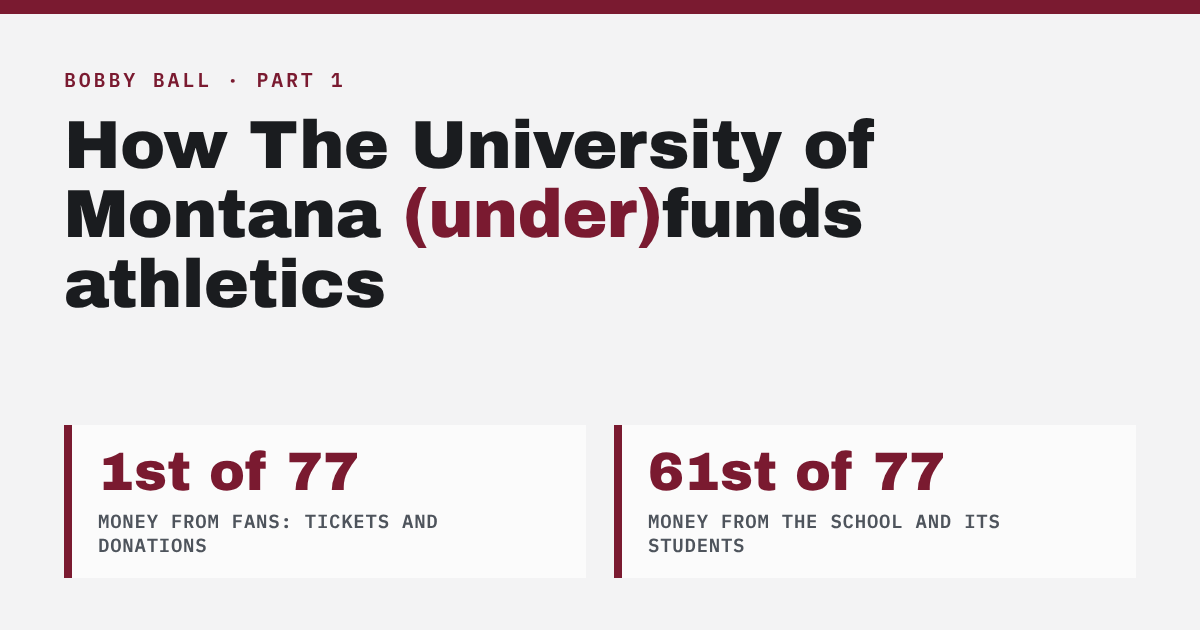
The business of Montana football brings in $13 million to $15 million a year and is allowed to spend $9 million. The university underfunds the rest of its sports and pays for them with football’s money.
How The University of Montana (under)funds athletics
The business of Montana football brings in $13 million to $15 million a year and is allowed to spend $9 million. The university underfunds the rest of its sports and pays for them with football’s money.
Mike Nugent came into the Griz Fan Pod on Sunday night already hot. "The fans have done their part year after year after year. They come, they buy tickets. They show up. ... The players are trying their hardest. The leadership has set up this program to fail for years." Three days later Andrew Schmidt delivered an epic rant on Big Sky Breakdown about the same department and landed here: "You sat on it, and you said, the people will come no matter what. ... We don't need the athletic fees. We don't need to charge the students. We could just rely on the golden goose of Griz football."
We were off this week, which leaves everybody time to argue, and the argument has moved off the defense and onto the people who fund it. And that is mostly not the University. Last year AD Kent Haslam said that getting less support from its own university than any other department in the Big Sky is "a real pride point for us."
Last in the Big Sky in school financial support
It's asked often: how do we have the stadium, the fans, the donors, the history but only two football league titles to show for it in seventeen years (2011 happened folks). It’s pretty simple: the university and athletic department haven’t been doing their part for years, and it's caught up with us. Wa-Griz turned 40, and it's showing.
A rash of injuries out of a weight room where, until this summer, the money covered one paid football strength coach. A head coach whose base salary is less than the offensive coordinator's in Bozeman. All told, we have spent $3.8 million less over the last nine years on the things that directly affect the quality of team on the field.
The University has stiffed the athletic department, the department has failed to increase contributions, and football has been the program that has paid the price. Every FCS school directs general funds to its athletic department, and all but a few send student athletic fees too. The University of Montana is dead last in our league on both.
Across the nation, we rank 61st out of 77 in university and student support among all public FCS schools. We are one of only a handful of flagship universities in the whole subdivision, and this is frankly embarrassing.
The median Big Sky athletic department gets $14.6 million a year in student fees and university funds. Ours gets $10.4 million. Football makes up the difference
Our department still spends $30.8 million a year, fourth in the Big Sky, because our fans put in $13.1 million, the most in the league. Give it the median school-provided check and we would spend $35 million, more than Bozeman. That additional $4.2 million the school should be spending would fund the other sports, and let football keep what it makes. Add up the money that comes off football Saturdays and the business of Montana football brings in $13 million to $15 million a year. Football is allowed to spend $9 million of it. That’s how the university gets away with putting $4.2 million a year less into athletics than the median Big Sky school, and it can’t be allowed to continue.
Football brings the department $4 million to $6 million more than it’s allowed to spend. In fiscal 2025 the football gate and game-day sales brought in $6.9 million and the QB Club another $1.1 million, against $8.9 million of spending. Our ticket sales alone cover 72 percent of what football spends on the field. The $13 million to $15 million figure comes from $9.1 million the department reports as football related, plus $4 million to $6 million more that should be counted that way: the sponsorships, the required seat donations to the GSA, and the rest of the money the department categorizes as general revenue, but is money that only exists because 26,000 people show up for football. Football isn’t currently charged for the buildings, but it more than pays for them. We are happy to add that $1.2 million line item to football’s tab once the University starts paying its fair share and football gets to keep and spend what it produces.
The money that leaves football’s pocket hasn’t bought the other fourteen sports much either. The Brawl of the Wild all-sports series keeps score on every Cat-Griz matchup of the school year, across every sport both schools play, with the football game worth two of the seventeen points. It started a year into Haslam’s tenure; we won the first three, and Bozeman has won the last ten, 111 points to 48. We are getting routed by our rival in football and across the board. When the failure is department-wide, it falls on the head of the department.
I offer the following as a preemptive response to the oft repeated claim that U of Montana is simply too cash-strapped to provide more funding. Northern Colorado lost eight football games last year in front of 4,189 fans a game. Its stadium seats 8,533 and it has about 8,800 students. Its latest report shows $204,076 in football ticket sales. Eastern Washington lost seven games and drew 5,206 at Roos Field. It has 9,900 students, has considered shuttering its football program numerous times, and its latest report shows $553,186 in football ticket sales. Both schools still put about $17.5 million each into their athletic departments, $7 million more per year than us. If the University of Montana is broker than EWU and UNC, we need to have an even bigger conversation.
Bozeman spent on the weight room. We're paying in the training room.
Bozeman's gate revenue nearly doubled over nine years. Our gameday revenue grew too, and stayed ahead of Bozeman's, while our school's check to athletics barely beat inflation. One school read a growing gate as a reason to invest. Ours read it as permission to stop.
Bozeman spent the money where it shows up on Saturday. Its coaching line went from $1.4 million to $2.2 million. Scholarships went from $1.8 million to $2.9 million, and the support staff line nearly doubled. Ours moved, but by less, every time. First the Cats passed us in the budget. Soon after, on the field.
Bozeman hired Sean Herrin as Director of Football Strength and Conditioning in December 2020 and opened an $18 million athletic complex with a new weight room the next fall. Vigen called Herrin "the most important piece" in January. We hired Dan Ryan into the same title a month after Herrin, from Idaho State, where the Bengals went 13–21 in his three seasons running the strength program. For his first five years at Montana he was the only full-time football strength coach, with graduate assistants under him. This June one of those graduate assistants, Ross Sangalang, was promoted to assistant strength coach.
Herrin is on Bozeman's salary list this year at $132,000. Ryan was on the state payroll in 2024 at $72,000. Bozeman hired its first athletics dietitian in 2017 and opened a fueling station that spring. Bozeman budgets $474,000 for football team meals this year. Missoula budgets $363,000. Montana hired its first sports dietitian last fiscal year. We got her from Bozeman.
Schmidt: "Are all these injuries luck? Are all 13 of them, 14 of them luck? Or are they training-related?" It's the right question. Strength and conditioning is staff and food, and both cost money. Ours ran on one full-time football coach and a rotation of graduate assistants with no dietitian while Bozeman built a staff and a fueling station around Herrin. Shortchange the weight room and you pay for it in the training room.
Bodnar left the school's check last in the league, and rather than fundraising his ass off, Haslam made do with what was left
Two people are responsible, and I'll name them. Seth Bodnar was president from January 2018 until he resigned this January. The university's check to athletics grew about 4 percent after inflation from his first full year to his last, and it finished last in the league.
Kent Haslam has run the department since 2012. In that time he has not raised money to match the football revenue machine he was handed, and has not successfully lobbied the regents for an increased student fee that matches the rest of the league, or otherwise gotten the University to pay what it should for the rest of the school's sports. Fourteen years with the biggest fan advantage in the league, and our donor dollars line is no bigger than Bozeman's.
The fundraising is the part that should make you angriest, because it is the part an athletic director is hired to do. In 2016 our donors gave the department $4.9 million. Bozeman's gave $3.2 million. MSU doubled its donor line in nine years. We grew ours by less than 30 percent.
Everything else on our wish list runs through the same office. The stadium repairs, the press box, an expansion, and an NIL fund that can keep a defense together. Every one of those is a private-gift project, and the department that has to raise the gifts is the one with the track record I just described. The quickest way to grow the donor line is the one Bozeman used: build something to which people want to give their money. In Missoula our stadium is consistently full. Why haven’t we added more seats in 18 years? More seats, more GSA fees, more tickets, more concessions. Bozeman is already on it: last month the Regents let Montana State spend up to $5 million of fundraised money to plan expanding Bobcat Stadium again. Unless we make drastic changes soon, they will pass us there too.
An athletic director who is proud of how little his university gives him while also failing to materially increase contributions is proud of the decline he’s overseen. The thing about a tightening budget is you can’t see the effects right away. Our decline started more than ten years ago, but nobody noticed. Back then the stadium wasn’t rusty and the play clocks still worked, the conference title streak wasn’t that far in the rearview and we all kept believing RTD was right around the corner, not knowing Rome was already on fire.
Leadership loves football out loud. Talk won't get it done anymore.
President Bodnar, last September: "We don’t take fan support lightly. We don’t take it for granted." His budget decisions did in fact make it look like he took us for granted. The university's own news service, last August: Grizzly Athletics "generates nearly $100 million annually from game-day attendance." The golden goose lays a hundred million for the town and gets fed on what's left.
Our donors give the department about $6.2 million annually for operations. Of this, the department marks about $1.1 million for football, which is just the amount QB Club raises for football, which can’t go anywhere else. The department says QB Club gifts “go directly into Coach Kennedy’s discretionary fund, where he is able to use it for the areas of greatest need,” and then names those areas: summer school, player nutrition, recruiting. Those are a football program’s basic operating costs, sold to donors as extras.
This past January Kent Haslam listed the department's goals, among them to "Win a national championship in football." Then he published the list of what the department is building: the Lady Griz locker room, the volleyball locker room, the auxiliary gyms, restrooms at the softball stadium, the soccer locker room. Five projects, five good causes, and not one of them is for the football program.
The last football-specific upgrade I could come up with was the football locker room in the Champions Center, in 2017. Nine years ago. This summer's new turf, with Montana Knife Company signed on as the on-field sponsor, doesn't count. Turf is tires: you replace it when it goes bald, and nobody gets credit for new tires on a car whose headlights, stereo and display screen burned out at the same time (play clocks, sound system, GrizVision). New grass to run on doesn't change a damn thing about the quality of the team. It's maintenance, and there's a bunch more to do.
Haslam’s last public contract expired June 30, 2026. The university hasn't released anything that replaced it, and nobody seems to know what he's working under or for how long. The office he answers to now belongs to President Shinn, who took it on July 1. To his credit, Shinn has said Grizzly Athletics "serves as the front door to the University." New presidents often bring in their own leadership. If that is coming here, Shinn should hear from us not only that the university needs to pay its fair share for the other athletic programs, but also what kind of athletic director this program needs, and why.
What I’m demanding: the money football earned, and an AD who'll raise more
No athletic department in FCS relies more financially on its football fans, so we have more right than any fanbase to demand better from the program we pay for. We’ve done more than our share for a long time, it’s time for the school to step up.
I'm demanding three things:
- The school: put up or shut up. Pay for the rest of the department’s sports so football can spend what it makes. At minimum, that means funding athletics at the league median, $4.2 million more per year. How this can be accomplished is probably a combination of increasing the student athletic fee (our students send athletics less fee money than any school in the conference) and by moving other dollars around. The front door is hanging off its hinges.
- The athletic department: Raise more money. QB Club isn’t the department’s gift to football. GSA football season ticket fees don’t count as fundraising, and those two are where almost all of our contributions currently come from. Either get the University to pay for the rest of the sports, or raise enough that football can keep what it’s already bringing in.
- President Shinn: fill the athletic director role with a person who is "trying to set records for the amount of money raised in an entire year, and the amount of new donors in every year, and the amount of NIL money that you earn every year, every quarter, you should be beating the bushes until you are the best at your position and Alabama wants to hire you,” as Schmidt put it. That job has gone undone here for fourteen years.
What we can do: Hold their feet to the fire, nicely
A few of you have told me you are done donating until change happens. I understand it, and I am asking you to keep sending the checks anyway. Nugent has a better plan: "You know what I actually think the best thing that people could do right now? Do not be negative, but send an email to the president, telling him why UM football is important to you and why you think it matters to the University of Montana." And the ground rule: "Shinn will love hearing why football matters to people. Don't be a jerk. We don't need that."
We have a new president with a great track record at Boise State, where he was interim president before he took this job, who people seem to like, and who has already said more warm things about football than his predecessor managed in eight years. So write him. Tell him how important Griz football is to you and what it has meant to you. Your game-day stories. Your hopes for this team. Your memories of the years we dominated. What a Griz Saturday does for this community and this state. How much you love the University of Montana.
Leave the insults out; the numbers above are the complaint, and your letter is the reason for change. The button below generates an email to the President in your own words and copies the commissioner and the Board of Regents. The counter under it is running. Let’s get 500 emails sent by the Brawl.
This is part 1 of a series. I have no idea how long it will be.
Go Griz.
Bobby Ball · The ask
Write to President Shinn
Speak from the heart and don't sweat the wording. The form tidies up your writing and adds the numbers that back you up. Nothing sends from this page: your letter opens in your own email, where you can change anything before you hit send. Be warm, don't be a jerk. He'll read the nice ones.
0 Griz fans have written President Shinn
Letters by town
Privacy: nothing you type here is sent anywhere except to your own mail app. The only thing counted is that a letter was written, and the town.
Every excuse dies on the drive to Bozeman
I have heard all of these, so I’ll get out in front of them now, and I’ll keep adding to the list as new ones come in. If you think you’ve thought of something I haven’t, you might find the rebuttal live updated below.
"Title IX." Title IX caps nothing about football money, and I wish we would stop saying it does. It asks that roster spots and scholarship dollars track enrollment and that everybody gets treated the same, and Bozeman's school puts $14.3 million into athletics, to our $10.4 million, while meeting all of it.
"The Regents make the schools fund athletics the same." No Regents policy says that. Policy 1202.2 says athletics "should be funded in a manner that will provide a budget sufficient to allow the institutions to be competitive in their respective conferences," with "due regard to the sources and percentages of support being received by the other participants in the conference." The median Big Sky school puts $14.6 million into its department. Ours puts in $10.4 million, last in the conference. MSU athletics brought in $4.1 million more than Montana athletics in 2025. The gap is almost entirely the difference in school-provided funding.
"The Regents won’t let us raise the student fee." The Regents’ fee rule, Policy 940.28, takes three steps: the campus asks for a fee, the Board sees the results of a campus vote, and the Regents approve it. In May 2025 they approved UM’s last request, $6 a semester this year and $5 next year. At $87 a semester, we still charge less than every Big Sky school that publishes its fee except Weber State. The cap is what the campus asks for and what we can sell students on what value it will create.
"The university was broke." Schmidt: "We're always broke. We always can't find the money and we're always like, where's the money gonna come from? We have a school full of lawyers and finance majors." I'll grant that Bodnar took over a university in a financial mess and did what he had to do, maybe. Eastern, Northern Colorado and Northern Arizona found the money with less. We are nearly a decade past the mess, and the football program is the part of campus still paying for it.
"Self-funded means we're efficient." Efficient is not the word that comes to mind for me when I think to describe what motivates the school to abandon the financial advantage our football program should enjoy from the best ticket business in the Big Sky. Words that do come to mind are dumb, cheap, and shortsighted.
"Football runs a surplus, so football is fine." The surplus is the other fourteen sports' allowance. Go back up to all the essential things football is being forced to cheap out on; that is where the allowance should be being spent.
"That's the Foundation's money and the GSA's money. The university can't direct it." The athletic director directed it himself, in the January letter: five facilities projects, none of them for football. The GSA is funded mostly by football season tickets. Probably about 90 percent, if I had to guess.
"We're a small school." Football can't live and die with the student population. My freshman year, 2010, enrollment was about 40 percent higher than it is now, and the school wasn’t blowing out the football budget then either. Fewer students is the reason to send football more of the check, not less: a university that wants to grow its enrollment could try investing in the only thing that puts its brand on national television. We have tried investing in the school and holding football flat. Let's try something else.
"Per student, we give plenty." It’s a made-up metric. Student fees are 3.9 percent of our athletic revenue, the only part that moves with enrollment. The university’s $9.2 million is a choice, and it’s the smallest in the league. We don’t have the smallest enrollment in the league.
What Haslam gets credit for
Haslam has built two things, and both deserve credit. The Washington-Grizzly Champions Center opened in 2017: a state-of-the-art weight room, locker room and meeting space, built on a $7 million lead gift from the Washington family, more gifts behind it, $400,000 of athletic ticket money and a $5 million state loan. UM's website calls it 100 percent privately funded. A building is worth what you put into running it, and for five years we ran the Champions Center's football weight room on one full-time coach.
The indoor practice facility opened in 2024 for $10.2 million: another Washington lead gift, about $2 million from the QB Club, and a bank loan the university secured. It's an inflatable dome Haslam chose because it was much cheaper than a permanent building, and it has popped twice since. At the exact same time, Bozeman raised $26.5 million from donors for a permanent one. The wiser move was to take the initiative and raise the $26.5 million for a building that stays up in the wind.
Every Griz sport shares these facilities, save the football locker room, and neither one is the stadium. Between 1995 and 2008 the stadium itself grew three times, from 12,500 seats to 25,217. In Haslam's fourteen years it has grown zero times. The lights that went up his first spring were a Jim O'Day project, the press box is still a promise, the deferred maintenance hasn't been done, and the sound system and the play clocks didn't work for the first few games this season. In a 25,000-seat stadium. It was embarrassing.
Chart 2 sets each football program's ticket sales against its operating spending, from each school's NCAA report. Montana and Montana State are on a regular-season basis, using the corrections from Montana State didn't spend $13.4 million on football: post-season and facilities lines come out of spending, and Montana State's fiscal 2025 playoff gate, about $1.2 million, comes out of its ticket line. Eastern Washington's figures are fiscal 2024, its latest report; Northern Arizona hasn't published its own. The $13 million to $15 million estimate counts football's own revenue on its NCAA report plus 90 percent of the department-wide sponsorship, donation and other operating money; the university's report credits football with 92 percent of ticket sales and 90 percent of parking and concessions, so I'm assuming the same 90 percent for the rest until the university gives me its own split.